


You've got a truck, a dream of remote campsites, and a growing pile of gear. But before you hit the trail, one question stops you cold: bed rack or roof rack?
It's the overlander's dilemma — a choice that affects your safety, your wallet, and how you'll use your rig for years. Get it wrong and you're stuck with a setup that kills your fuel economy, limits your trail access, or worse, fails you on a rocky side slope where it really matters.
The internet is full of conflicting advice, brand-biased reviews, and myths that just won't die. This guide cuts through all of it. We've analyzed manufacturer specs, real-world data, and the experiences of overlanders who've been in exactly your boots. No fluff. No favoritism. Just the facts you need to make a confident decision — and walk away knowing your rig is ready for the adventure ahead.
This comparison focuses on the key trade-offs. If you're still deciding which rack type fits your truck's payload and build goals, start with our Overlander's Guide to Truck Bed Racks — it covers measurements, load ratings, and installation before you spend anything.
A bed rack is a frame that mounts to the bed rails of your pickup truck, creating a raised platform above the bed floor. It turns your truck bed into a versatile, multi-level cargo system. You can mount a rooftop tent, recovery boards, awnings, and gear on top — while still using the bed floor for coolers, drawer systems, or a spare tire. Bed racks come in low-profile (cab-height) and full-height (above the cab) configurations, fixed or adjustable.
Browse our full bed rack collection to compare models by height, material, and vehicle fitment. Popular picks include the upTOP Workhorse, Leitner Designs ACS, and Backwoods Adventure Mods racks — all designed specifically for overlanding loads.
A roof rack mounts to the cab roof of your truck, SUV, or van. It's the traditional way to carry long, lightweight items — kayaks, lumber, ski gear, or a cargo box. For overlanding, cab roof racks are often used for lighter accessories or as a secondary storage platform alongside a bed rack. They require crossbars and a mounting system specific to your vehicle's roof type: naked roof, raised rails, or fixed factory points.
For a deeper dive into what makes a roof rack safe for overlanding loads, our guide on choosing the right roof rack for your rooftop tent covers dynamic weight ratings, crossbar spacing, and vehicle compatibility in detail.
Before we go deep on the numbers, here's the honest side-by-side. The "Winner" column reflects the better choice for most overlanding scenarios — not an absolute verdict for every use case.
| Factor | Bed Rack | Roof Rack | Winner |
|---|---|---|---|
| Dynamic Weight Capacity | 300–800 lbs (typical) | 100–200 lbs (typical) | BED RACK |
| Static Weight Capacity | 800–1,200+ lbs | 400–600 lbs | BED RACK |
| Center of Gravity | Lower (over rear axle) | Higher (on cab roof) | BED RACK |
| Aerodynamics / MPG Impact | Moderate (behind cab) | High (exposed on roof) | BED RACK |
| Installation Complexity | Moderate (bed rail clamps) | Moderate–High (may require drilling) | TIE |
| Tonneau Cover Compatible | Some models yes | Not applicable | BED RACK |
| Best for RTT & Heavy Gear | ✅ Yes | ❌ Rarely | BED RACK |
| Best for Long, Light Items | ❌ Not ideal | ✅ Yes | ROOF RACK |
| Entry-Level Cost | $400–$800 | $200–$500 | ROOF RACK |
| Vehicle Height Increase | Minimal | Significant | BED RACK |
| Gear Access Ease | Easier (bed height) | Harder (overhead) | BED RACK |
| Works on Non-Trucks (SUVs, Vans) | ❌ Trucks only | ✅ Universal | ROOF RACK |

A properly loaded bed rack — tent, awning, and recovery gear — without exceeding the dynamic weight rating.
Here's where most people get tripped up. Dynamic weight capacity is the maximum load a rack can safely carry while the vehicle is in motion. This is the number that actually matters for overlanding — because that's when physics gets violent on a rocky trail or a highway emergency maneuver.
Static weight capacity is how much the rack can hold when parked. It's relevant for people sleeping in a rooftop tent, but it's not the number you use to determine if your rack can handle the drive to the trailhead. Many overlanders make this mistake — and it's a dangerous one.
Concrete numbers: a quality bed rack typically handles 300–800 lbs dynamic. A typical cab roof rack is rated 100–200 lbs dynamic. The Yakima OverHaul HD, for example, is rated 500 lbs dynamic and 800 lbs static. Exceed the dynamic limit and you're gambling with rack failure at speed.
For the full breakdown of how weight ratings work and how to verify your truck's own roof or bed load limits, read our bed rack payload capacity guide — it covers the math, the ratings, and what real overlanders actually carry.
Let's make this concrete. A typical hard-shell rooftop tent weighs 130–180 lbs. Add two adults (approximately 350 lbs) and you're at 480–530 lbs of static load. A bed rack handles this without breaking a sweat. Most cab roof racks cannot — and the few that can are still working at or near their dynamic limit before you even strap down your Hi-Lift jack.
Add a full jerry can (~40 lbs), recovery boards (~20 lbs), and a winch bumper, and you're quickly past what any roof rack was designed to carry. A bed rack doesn't blink at this load — it's doing exactly what it was engineered for.
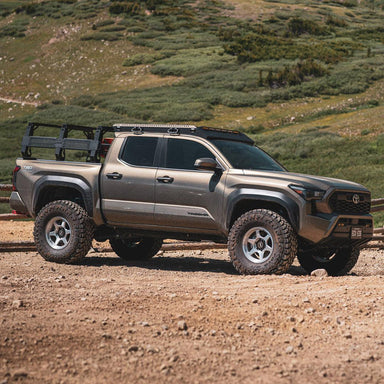
A full-height bed rack sits behind the cab — partially shielded from the direct airstream that hits a roof-mounted rack head-on.
Any rack adds some aerodynamic drag. But the position in the airstream is everything. Roof racks sit directly in the fastest-moving air above the cab, creating significant drag from the moment you hit highway speed. Bed racks, sitting behind the cab, benefit from the wake of the cab — they're partially shielded from the direct airstream.
The U.S. Department of Energy's published data on cargo accessories gives us a framework: a large blunt rooftop cargo box creates a 10–25% fuel economy penalty at interstate speeds. A rear-mounted cargo tray — aerodynamically much closer to a bed rack than a roof box is — creates only a 1–5% penalty on the highway. Bed racks, loaded at or below cab height, track much closer to that rear-tray number.
Real owner data from overlanding forums tells the same story. Drivers running a bed rack with an RTT at cab height reported 0–1 mpg change. Those with tall tents and heavy loads stacked above the roofline reported 2–4 mpg losses. Roof-rack setups with exposed tents consistently came in worse.
For the full breakdown with real owner numbers, check our dedicated article: how much MPG do you really lose with a bed rack — it includes a DOE-sourced estimator tool.
No rack is free from aerodynamic drag, but you can minimize the penalty significantly. Keep your load at or below cab height whenever the build allows — this is the single biggest variable. A low-profile or mid-height bed rack creates dramatically less drag than a full-height rack with a tall tent riding above the roofline. Remove crossbars when you're not overlanding, strap gear tight so nothing catches wind, and consider a retractable tonneau bed cover that's compatible with your rack for better bed airflow management.
Center of gravity (CoG) is the single most important factor for off-road safety, and it's the one most overlanders underestimate until they've had a scary moment on a side slope. A lower CoG means less body roll, better traction on articulated terrain, and more predictable handling when you need it most.
On a 20-degree side slope — which you'll encounter on many legitimate off-road trails — a roof-loaded truck can feel genuinely terrifying. A bed-loaded truck stays planted. In rock crawling, where the suspension articulates over obstacles and the vehicle pitches dramatically, a high CoG can cause sudden loss of control. Bed racks keep the weight low and centered, improving traction at every wheel and reducing the risk of rollover in off-camber situations.
I've seen too many rigs with roof racks sagging under a tent they were never rated to carry. Don't let that be you.
For more on how overlanding gear choices affect your rig's performance and trail capability, browse the ExtrailAuto Overlanding Blog — we cover real builds, real trails, and gear decisions that actually matter on the trail.
If a rooftop tent is in your plans, a bed rack is almost always the better choice. Full stop. It provides the necessary dynamic and static weight capacity, keeps the tent at a manageable height for setup and entry, and doesn't compromise off-road stability. Most hard shell rooftop tents weigh 120–200 lbs — often at or near the dynamic limit of most cab roof racks before you even add occupants or bedding.
Cab roof racks can work for very lightweight soft-shell tents on vehicles with high roof ratings and low overall weight. But it's a compromise — you're accepting a higher CoG, more drag, and a tent that's harder to climb into, especially for kids or anyone with mobility concerns. For most overlanders running a truck with a tent, the bed rack is the correct platform.
Beyond tents, here's how the two rack types handle the rest of your gear list:
Awnings: Both rack types can mount overlanding awnings, but bed racks deploy them at a comfortable, usable height. A cab roof rack awning is often too high for practical use without a step stool. Bed rack awnings shade your camp area naturally without engineering workarounds.
Recovery gear (Hi-Lift, MaxTrax, straps): Bed racks give you ample mounting real estate for bulky recovery items. Everything is accessible from ground level — no reaching overhead, no fumbling on a ladder when you're already in a stressful recovery situation. Roof racks can work for MaxTrax, but they add wind noise and require more effort to access when it counts.
Bikes and kayaks: This is where roof racks genuinely shine. For long items that don't fit vertically in a bed rack setup, a cab roof rack is the right tool. This is exactly why the hybrid setup is so popular — bed rack for the heavy overlanding kit, roof rack for bikes, kayaks, and light recreational gear.
Most bed racks use clamp-on systems that attach to the bed rails without drilling. This is a significant advantage for lease vehicles, for people who want to keep modifications reversible, or for anyone who might want to sell the truck later without evidence of modifications. Some heavy-duty bed racks may add through-bolts for added security on the most demanding builds, but even these are typically cleaner than roof rack drilling.
Many cab roof rack systems, by contrast, require drilling into the roof if your vehicle doesn't have factory mounting points. This is a permanent modification that can lead to water leaks if not done correctly — and improperly sealed roof penetrations are one of the most common sources of interior water damage in overlanding rigs. If you're going the roof rack route on a bare roof, budget for professional installation.
Bed racks are generally more universal — they clamp to standard bed rails and fit a wide range of truck bed lengths. You'll still need to check compatibility with your bed length, any existing bed liner, and any tonneau cover you're running. Cab roof racks require a specific fit kit for your vehicle's year, make, and model, which means a higher chance of fitment headaches and longer wait times if your vehicle isn't a common platform.
Here's the question we get constantly: can you run a bed rack and a tonneau cover at the same time? The answer is often yes — but it depends on the rack design and the cover type. Retractable covers that roll into a canister at the front of the bed leave the side rails fully accessible for bed rack mounting. Some manufacturers like Retrax and BAK offer covers with integrated T-slot channels that accept specific bed rack systems. Low-profile racks can sometimes clear folding covers entirely. For a complete guide to which combos actually work, check our article on bed rack and tonneau cover compatibility — including which cover types to avoid if you're planning a rack later.
Basic steel racks, fixed height, simple crossbar designs
Adjustable aluminum racks, modular systems with accessory compatibility
Leitner ACS, upTOP, full-featured modular systems with side panels
Basic crossbars and towers, minimal weight capacity
Aerodynamic bars, low-profile platforms, better fitment kits
Sherpa, Rival, and Leitner full platform systems with accessory ecosystems
The sticker price is only the beginning. Professional roof rack installation (especially if drilling is required) can add $100–$300. Accessory mounts — awning brackets, recovery board holders, bike trays — add up quickly on both rack types. A fully kitted bed rack system with side panels, a tent mount, and awning arm can easily reach $3,000+ once you've accessorized it properly.
And don't forget the fuel economy penalty. Over 20,000 miles per year with a 10% roof rack MPG penalty on a 20 mpg truck consuming $3.50/gallon fuel, you're looking at roughly $350 extra per year just to drive around with an empty roof rack. A bed rack at a 3% penalty costs you closer to $100. Over five years, that spread pays for a significant upgrade.
Also account for the weight of the rack itself. A heavy steel bed rack can eat 80–120 lbs of your truck's payload before you put a single piece of gear on it. Know your truck's payload limit and subtract the rack weight before you start calculating what you can carry. Our steel vs. aluminum bed rack guide breaks down how material choice affects rack weight, durability, and total cost of ownership.
Your rack choice should reflect how you actually use your truck — not how you plan to use it someday. Here's how five common overlanding profiles map to the right rack.
Monthly camping trips, ground tent, cooler, kayak. Truck is a daily driver. → Roof rack or basic bed rack. Either works. Roof rack wins on simplicity and cost if the kayak is a priority. Upgrade to a bed rack later if RTT ambitions grow.
Rooftop tent, recovery gear, camp fridge, overlanding-focused. → Bed rack. Clear winner. Weight capacity, CoG, tent height, and access all favor the bed rack for this profile.
Weeks on the road, RTT, awning, extra fuel, full recovery kit, water storage. → Heavy-duty bed rack (800+ lbs dynamic) + optional cab roof rack for light items. Modular bed rack with a drawer system is the gold standard here.
2 adults, 2 kids, a dog. Large RTT or ground tent, comfort-focused. → Bed rack with large RTT + awning room. Lower tent entry height is a real quality-of-life win with kids. The bed handles bulky family gear; a cab roof rack handles the bikes if needed.
Bivy or swag, basic kitchen, minimal gear. Low cost, low complexity. → Budget bed rack or basic roof crossbar system. Don't overbuy. A simple setup done well beats a complex one done poorly.
Inspect all mounting points after every off-road trip. Trail vibration loosens bolts over time — especially on corrugated dirt roads. A rack failure at speed or on a side slope is catastrophic. Make a 10-minute inspection part of your post-trip routine.
Buy modular if you're not sure. Systems like the Leitner ACS and upTOP racks let you add crossbars, side panels, and accessories as your overlanding kit evolves. Starting modular costs more upfront but avoids the expensive cycle of buying a system and replacing it when your needs change.
Load heaviest gear low and forward. On a bed rack, push heavy items toward the cab and as low as possible. On a roof rack, the same principle applies — forward and flush to the rack surface, not piled high.
Verify dynamic weight rating before you buy anything. Ask the manufacturer directly if the published spec is static or dynamic. Some brands list static ratings prominently and bury the dynamic number in fine print. That number is the one that matters when you're moving.
Consider the used market. Overlanders upgrade frequently. A well-maintained Yakima OverHaul HD or upTOP rack from a forum sale can be a significant saving over retail. Buy used only from verified sources and inspect all mounting hardware before trusting it with a load.
Sarah started with a cab roof rack and a lightweight RTT on her Toyota Tacoma. After a scary off-camber moment on a Colorado trail — "the truck felt like it wanted to tip over the whole descent" — she switched to a Leitner Designs ACS bed rack. The difference was immediate. "The stability was night and day. I also love that I can reach the tent without a ladder, and my dogs can climb up without me lifting them." She's added a side awning and a MaxTrax mount since then and hasn't looked back.
"The roof rack worked until it didn't. The bed rack just works."
Mark uses his F-150 for both overlanding and hauling lumber for his contracting business. He installed a Yakima OverHaul HD bed rack for his RTT and recovery gear, and kept his Sherpa cab roof rack for kayaks and lumber. "It's the best of both worlds. The bed rack carries everything that matters for camping, and the roof rack lets me use the truck as a truck the rest of the week." His MPG penalty with just the roof rack and no load? Negligible. With the full bed rack setup loaded for a trip? About 1.5 mpg — a trade he calls "more than worth it."
The Johnsons overland with two kids and a dog. They chose a bed rack with a large hard-shell RTT and an awning room. "The lower height makes it so much easier for the kids to get in and out — we're not hoisting a seven-year-old up a six-foot ladder at 10 PM," says Mike Johnson. They also run a Decked drawer system in the bed for gear organization. "We camp more comfortably than most people do in a ground tent, and setup takes under ten minutes."
For most overlanders, especially those running a truck with a rooftop tent, heavy recovery gear, or planning serious off-road use, a bed rack is the superior choice. It offers higher weight capacity, better stability, lower fuel economy impact, and easier gear access. Roof racks have their place — for SUVs and crossovers where a bed rack isn't possible, and for long, lightweight recreational gear like kayaks and bikes — but they're not an ideal primary overlanding platform on a truck.
The decision comes down to three questions. Answer them honestly and the right setup becomes obvious.
Answer 3 quick questions — we'll point you to the right setup.
Ready to build your rig? Shop bed racks or browse roof racks — and if you're still unsure which height or style is right, read our truck bed rack decision framework for a step-by-step guide.
Choosing between a bed rack and a roof rack isn't complicated once you're honest about how you actually use your truck. For the vast majority of truck overlanders — especially anyone running a rooftop tent or serious recovery gear — the bed rack is the right call. It's safer, more capable, and more practical for the long haul.
Here's your actionable checklist:
For more on building the ideal overlanding setup for your truck, browse the full ExtrailAuto Overlanding Blog — we publish practical, no-hype guides written for truck owners who actually use their rigs.
Leave a comment