


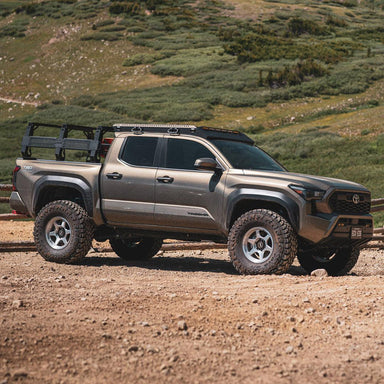
Yes, a bed rack affects gas mileage. No, it's probably not as bad as you think. Most bed rack setups cost somewhere between 1% and 8% of your fuel economy, depending on how high your gear sits and how much of it there is. That's a smaller hit than a roof-mounted cargo box, which can run 10-25% at highway speeds. The difference comes down to one thing: a bed rack keeps your load lower and closer to the truck's natural shape, while a roof box sits in the fastest-moving air above the cab.
The honest version: nobody can give you an exact number without a dyno and a controlled test track, because your specific hit depends on rack height, total weight, what's strapped to it, and how fast you drive. What we can do is show you the real published data on cargo aerodynamics, plus what actual truck owners are reporting, so you can estimate your own setup instead of guessing.
There are exactly two mechanisms at play, and almost everything else is noise.
Air doesn't care that your truck bed is "supposed" to be empty. Once something breaks the airflow above the bed rails, the truck has to push more air out of the way, and the engine burns more fuel to maintain speed. Drag increases roughly with the square of your speed, which is why this barely matters at 30 mph in town and matters a lot at 75 mph on the interstate.
A steel bed rack, a rooftop tent, recovery gear, water jugs — it all adds rolling mass. Heavier vehicles need more energy to accelerate and to climb grades. This effect is smaller than drag at highway speed but it's constant, in town and on the highway alike.
A bare bed rack with nothing mounted to it barely registers on either front — it sits low, inside the truck's existing profile, and weighs a fraction of what a loaded rack does. The real cost shows up once you start stacking gear on top of it, especially gear that's tall, boxy, or sits above the cab line.
Most articles on this topic stop at "it depends." Here's what's actually been measured.
That's the U.S. Department of Energy's published figure for a large, blunt roof-top cargo box — the worst-case scenario for rooftop drag.
Source: U.S. Department of Energy, "Driving More Efficiently" — figures are for general cargo boxes and rear cargo trays, the closest tested analog to a truck bed rack; no government study has tested bed racks directly.
Now here's the number that actually matters for a bed rack: a rear or bed-mounted cargo box or tray — much closer in mounting position to a truck bed rack than a roof box is — only costs about 1-2% in city driving and 1-5% on the highway, according to the same DOE data set. A bed rack isn't identical to a rear cargo tray, but it's a far closer cousin to it than to a roof box, which is exactly why bed racks generally hit your mileage less than people assume.
Add the two together and you get a reasonable estimate: drag from height plus a percentage point or two from weight. A bed rack sitting below the cab with a moderate load is doing roughly what a rear cargo tray does. A bed rack stacked to roof height with a tent and full camp kit starts creeping toward roof-box territory.
This is the part competitors gloss over: a bed rack and a roof rack are not the same aerodynamic problem just because they're both "racks." Position in the airflow is the deciding factor.
| Mounting position | Typical drag profile | Why |
|---|---|---|
| Roof rack / roof box | Highest | Sits in the fastest, most undisturbed airflow above the cab |
| Bed rack, above cab height | Moderate-high | Breaks airflow similarly to a roof box once gear clears the cab line |
| Bed rack, at cab height | Moderate | Gear rides in the truck's existing wake, less new frontal area |
| Bed rack, below cab height | Low | Stays inside the vehicle's natural air shadow, closest to a rear cargo tray |
This is also why a low profile rack and a full height rack aren't just a style choice — height is the single biggest lever you control on this whole question. If mileage is a real priority for you, that decision matters more than which brand of bed rack you buy.
Published lab data is one half of the picture. Owner-reported numbers from truck forums are the other — and they line up with the DOE data closely enough to trust the pattern, even though every one of these is a self-reported, uncontrolled estimate.
| Setup | Reported MPG | Notes |
|---|---|---|
| Cab-height bed rack + RTT, mixed driving | ~1 mpg gain vs. open bed | Tent height matched cab line, minimal added drag |
| Bed rack + RTT + winch bumper + lift + 33s | ~16 mpg | Multiple modifications stacked, hard to isolate the rack's share |
| Bed rack + RTT, low-profile, 70 mph highway | ~20 mpg | Tent stayed below roofline |
| Roof-top tent + ~600 lbs gear (no bed rack) | ~4 mpg loss | Tall tent fully exposed to highway airflow |
| Cab-height rack, empty | No noticeable change | "Won't hurt mileage any more than your mirrors," per owner |
Sources: TacomaWorld owner thread, Expedition Portal owner thread.
The pattern is consistent: owners who kept gear at or below cab height saw little to no change. Owners who stacked tall gear above the roofline, especially at sustained highway speed, reported the biggest losses. Total vehicle weight and tire/lift modifications muddy individual numbers, but the height effect shows up in every thread.
Answer two quick questions for a rough estimate based on the DOE ranges above. This is a directional estimate, not a guarantee — your actual mileage depends on your truck, tires, and driving style.
| Setup | Typical mileage impact | Rating |
|---|---|---|
| Empty bed rack, below cab height | ~0-1% | Minimal |
| Loaded bed rack, at/below cab height | ~1-5% | Low |
| Loaded bed rack, above cab height (tent/cargo) | ~5-12% | Moderate |
| Roof rack, loaded box, highway speed | ~6-17% | Moderate-High |
| Roof rack, loaded box, interstate speed | ~10-25% | High |
A bed rack will cost you some mileage, but the published data and the owner reports agree on the same conclusion: it's usually a modest hit, not a dramatic one, as long as your load stays near or below cab height. The real number to watch isn't the rack itself — it's how tall and how heavy your loaded setup ends up being once the tent, fridge, and recovery gear are strapped on.
Still deciding which rack to buy before you worry about MPG? Our complete bed rack buying guide covers material, height, mounting, and load capacity together.
Leave a comment