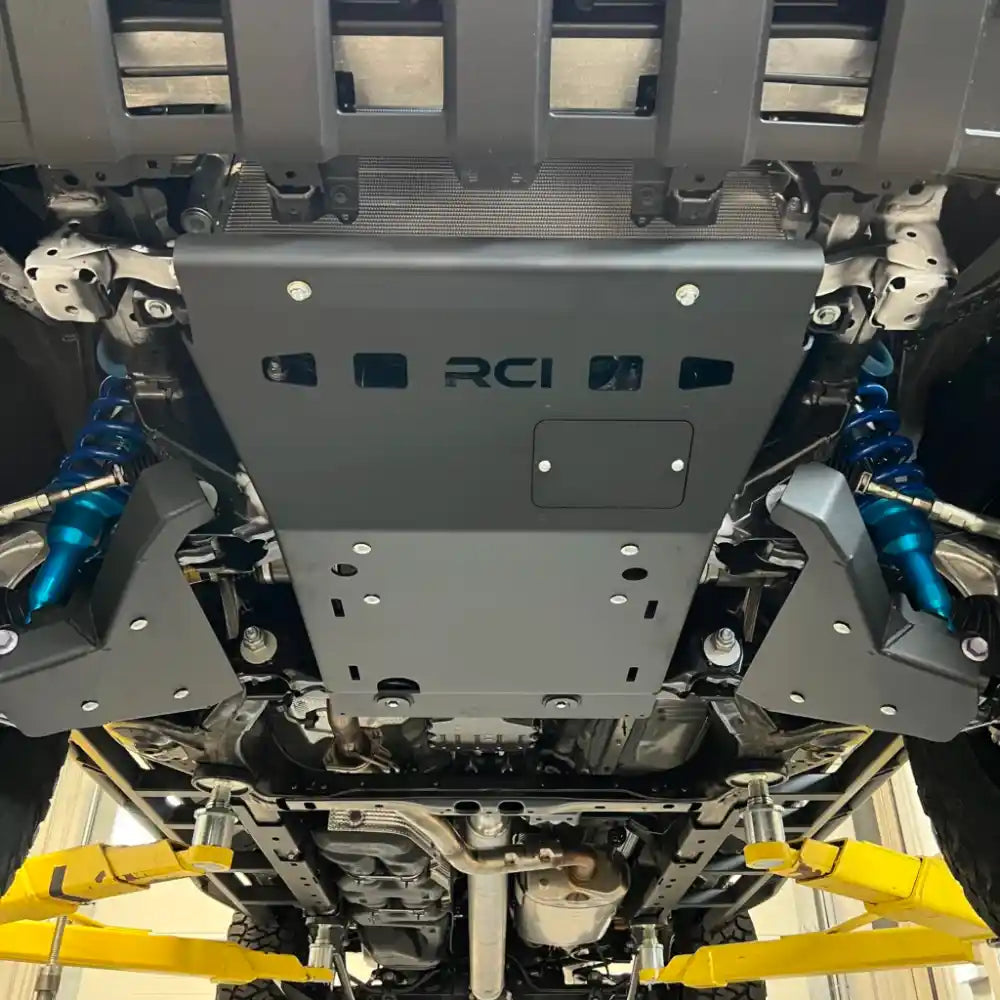
RCI Offroad steel skid plate installed on a Toyota Tacoma. This is what real off-road underbody protection looks like from below.
Shopping for off-road skid plates should be simple. But one look at the options — steel vs aluminum, full kit vs individual plates, $200 vs $1,500 — and most buyers freeze up. 😅
The forums aren't much help either. You'll find "just get steel" next to "aluminum is fine" in the same thread, with no clear answer on which brands are actually worth buying.
This guide cuts through all of it. You'll get a clear buying framework, an honest brand comparison, and a decision tool that tells you exactly what to buy based on how and where you drive. No brand bias. No fluff.
New to skid plates entirely? Start with our Complete Skid Plates Guide first, then come back here when you're ready to buy. 🔧
Is Your Factory Skid Plate Good Enough for Off-Roading?
Before you buy anything, check what's actually under your truck. Grab a flashlight and crawl underneath. Here's what you're looking for:
Plastic panels — these are splash guards, not skid plates. They protect against road debris and water, not rocks. Replace them.
Thin stamped metal (under 3mm) — common on entry-level TRD and OEM packages. Better than plastic, but not built to take direct hits on technical trails.
Thick formed metal with mounting flanges — this is real protection. If it has drain access doors and feels solid when you knock on it, you may be fine for light use.
🚨 The Factory Test: If your "skid plate" flexes when you press on it with one hand, it's not built for off-road impacts. Real skid plates are rigid. You should not be able to deflect them at all by hand.
Most trucks — even TRD Off-Road and Pro trims — come with protection that's adequate for mild gravel and road debris. The moment you start hitting real obstacles, you need aftermarket.
You don't have to protect everything at once. But some components are far more exposed than others. Here's the priority order — ranked by how often they get hit and how expensive they are to fix without protection:
1
⛽ Fuel Tank Skid PlateHangs dangerously low on most trucks. A puncture is a fire risk and a $800–$1,500 repair. Always first priority. Shop →
2
🛢️ Engine / Oil Pan Skid PlateMost exposed, highest impact frequency. One rock = possible engine seizure. $500–$2,000 repair. Shop →
3
⚙️ Transmission Skid PlateExpensive to fix, sits center-low. Often overlooked until it's too late. $800–$2,500 repair. Shop →
4
🔄 Transfer Case Skid PlateCritical for 4WD function. Crack this and you're stranded. $1,000–$3,500 repair. Shop →
5
🔧 Differential Skid PlatesAdd when budget allows, especially for rock crawling or aggressive line choices.
Full Skid Plate Kit or Individual Plates — Which Should You Buy?
This is the most common buying dilemma. Here's the honest breakdown:
Why a Full Kit Wins (Most of the Time)
A skid plate kit includes multiple plates engineered to work together — engine, transmission, transfer case, and sometimes fuel tank — in one purchase. The plates are designed to link up with no gaps between them. Rocks can't sneak through seams. Coverage is complete. And buying a kit is almost always cheaper than buying each plate separately.
Approach
Cost
Coverage
Best For
Full Kit
Best value
Gap-free, complete
Anyone wanting full protection now
Individual Plates
Higher per-piece cost
Only where you buy
Tight budget, building gradually
Mixed (kit + add-ons)
Medium
Customizable
Specific vehicle needs or mixed use
When Individual Plates Make Sense
If budget is genuinely tight, start with the fuel tank and engine skid only. You'll cover the two most critical and most exposed components for $300–$500. Then add transmission and transfer case later. Just make sure you buy from the same brand — mixing brands often creates fitment gaps and mounting conflicts.
💡 Kit Savings Example: Buying a RIVAL 4-piece aluminum kit for a Tacoma typically runs $600–$800. Buying those same four plates individually runs $900–$1,100. That's $200–$300 saved for the same coverage — and better fitment guaranteed.
📦 Shop Skid Plate Kits →RCI Offroad full skid plate system — gap-free coverage from front skid to fuel tank.
5 Things to Check Before You Buy Off-Road Skid Plates
Once you know what coverage you need, use this checklist to evaluate any plate before you order:
1. Material Matches Your Use Case
Steel (3/16" or 1/4") for rock crawling and serious trail use. Aluminum (4–6mm) for overlanding, mixed terrain, and daily drivers in rough areas. Don't pay for steel's weight penalty if you don't need it. Don't shortchange yourself with aluminum if you're regularly dragging over sharp granite. For a full breakdown, read our steel skid plate thickness guide.
2. Vehicle-Specific Fitment (Not Universal)
Universal skid plates need trimming, drilling, and guesswork. Vehicle-specific plates bolt directly to existing frame points with zero modification. Always buy vehicle-specific. The fitment is tighter, the protection is better, and the installation takes half the time.
3. Oil Drain Access Door
This one feature saves you more frustration than any other. A skid plate without an oil drain door means removing the whole plate every oil change. On a 3/16" steel plate that weighs 20–30 lbs, that's a workout every 5,000 miles. Check this before you buy.
4. Modular Design
You should be able to drop the transmission plate without removing the engine plate. Any system that requires pulling everything to access one component is a maintenance nightmare on the trail. Look for kits that describe modular or independent plate removal.
5. Powder Coat Finish (for Steel)
Bare steel rusts. Any steel skid plate exposed to moisture, salt, or mud without a protective finish will corrode. Powder coat is the standard — it bonds to the steel and provides lasting rust resistance. Some brands include it standard; others charge extra. Worth every cent.
How Much Should You Budget for Off-Road Skid Plates?
Here's a realistic breakdown of what your money gets you at three budget levels:
Starter$150–$400
Single Plate Protection
One or two individual plates
Engine or fuel tank coverage only
Entry-level aluminum or basic steel
Good for: light trails, budget builds
Brands: Cali Raised entry, RIVAL single plates
Mid-Range$400–$800
3–4 Piece Kit
Full coverage: engine + trans + transfer case
Quality aluminum or 3/16" steel
Oil drain access included
Good for: most overlanders and trail riders
Brands: RIVAL 4x4, Cali Raised LED full sets
Premium$800–$1,500+
Full Belly System
Complete underbody — all 5 areas
Heavy-gauge steel or aircraft aluminum
Modular, powder-coated, diff coverage
Good for: rock crawlers, serious builds
Brands: RCI Offroad, MillerCat MCX
Brand Comparison: Which Off-Road Skid Plate Brand is Right for You?
This is the question forums never answer objectively. Here's an honest breakdown of the brands you'll see most often — what they're actually best at, and who they're best for.
⚙️ RCI Offroad — Best for Steel & Heavy-Duty Builds
RCI is the go-to brand for drivers who want serious steel protection without compromise. Their plates are laser-cut from 3/16" mild steel, CNC bent, fully gusseted, and available raw or powder-coated. The modular design lets you drop individual plates for maintenance without removing the whole system.
✅ Best atHeavy-duty steel, rock crawling, durability
RIVAL is one of the most popular aluminum skid plate brands globally. Their 6mm aircraft-grade aluminum plates are precision-fit for specific vehicles, significantly lighter than steel, and naturally corrosion-resistant. Excellent for overlanders and drivers in wet or salty climates who want serious protection without the weight penalty.
✅ Best atLightweight aluminum, overlanding, corrosion resistance
🚙 FitsTacoma, 4Runner, Bronco, Wrangler, Maverick, Ranger, Land Cruiser
💰 Price range$250–$1,200 (kits)
⚠️ NoteNot ideal for aggressive rock crawling with sharp impacts
MillerCat's MCX skid plates are purpose-built for the newest off-road platforms — 2024+ Toyota Tacoma, 2025+ 4Runner, and Land Cruiser Hybrid. If you're running a newer vehicle that other brands haven't caught up with yet, MillerCat is often the best-engineered option available. Their MCX system is built from heavy-gauge metal with a focus on precision fitment.
✅ Best atNew platform fitment, precision engineering, newer Toyota builds
🚙 Fits2024+ Tacoma, 2025+ 4Runner, Land Cruiser Hybrid
Cali Raised LED offers solid aluminum skid plate systems at very competitive prices for Toyota trucks and SUVs. Their kits are popular because they hit a sweet spot of price, fitment quality, and finish. A great entry point for Tacoma and 4Runner owners who want reliable protection without maxing out their budget.
✅ Best atValue, Toyota fitment, full kit availability
🚙 FitsToyota Tacoma, 4Runner (primary focus)
💰 Price range$150–$700 (kits)
⚠️ NotePrimarily Toyota-focused; limited fitment for other makes
Answer 3 quick questions and get a personalized recommendation for your setup.
🎯 Off-Road Skid Plate Finder
3 questions · 60 seconds · Specific recommendation
1 of 3 — What best describes your off-road use? 🗺️
2 of 3 — What's your budget? 💰
3 of 3 — What vehicle do you drive? 🚙
Do Off-Road Skid Plates Work With Lift Kits and Aftermarket Bumpers?
This is one of the most common concerns on forums and it almost never gets a clear answer. Here it is:
Yes — quality aftermarket skid plates are designed to work with common suspension lifts (typically 2–3") without modification. Most brands test fitment on both stock and lifted vehicles. If you're running more than 3" of lift, check the brand's fitment notes specifically.
Mod
Compatible?
Notes
2–3" suspension lift
Yes ✅
Works with virtually all quality brands out of the box
4"+ lift
Usually ✅
Check brand fitment notes; some plates may need spacers
Aftermarket front bumper
Yes ✅
Most skid plates mount independently of bumpers
Rock sliders
Yes ✅
Rock sliders and skid plates are complementary, not conflicting
Long-travel suspension
Check first ⚠️
Significant geometry changes may affect fitment — confirm with brand
Rock sliders and skid plates are actually designed to work together — sliders protect the sides while skid plates protect the belly. For the full picture on off-road armor, read our guide: Rock Sliders, Skid Plates & More: Must-Have Off-Road Gear
Buying the wrong fitmentUniversal plates look cheaper but require cutting, drilling, and gap-filling. Always buy vehicle-specific plates. The time and frustration cost far exceeds the price difference.
❌
Mixing brands in a multi-plate setupPlates from different brands rarely share the same mounting points or edge profiles. The gaps between mismatched plates are exactly where rocks hit. Stick to one brand per setup.
❌
Skipping the transmission plateBuyers often protect the engine first and skip the transmission to save money. But the transmission is just as exposed and costs twice as much to repair. Don't leave it unprotected.
❌
Not checking for oil drain accessRemoving a 25 lb steel skid plate every 5,000 miles gets old very fast. Always check that your plate has an oil change access door before purchasing. Non-negotiable for any daily or regular driver.
❌
Installing in the wrong orderAlways install the transmission skid plate before the engine/front skid plate. The front plate's bolts overlap with the transmission plate's mounting points. Get the order wrong and you'll be unbolting everything to start over.
❓ Frequently Asked Questions
All quality aftermarket skid plates are sold by vehicle year, make, and model. Search by your exact truck (e.g. "2022 Toyota Tacoma skid plate") and buy vehicle-specific — not universal. Vehicle-specific plates bolt directly to existing frame mounting points with no drilling or modification.
Yes — most quality skid plates are bolt-on installations requiring only basic hand tools, a floor jack, and jack stands. A single plate takes 30–60 minutes. A full kit takes 2–4 hours. If you're comfortable working under a safely lifted vehicle, DIY is totally doable. If not, a shop charges $100–$300 for installation.
Slightly. A full aluminum kit adds 40–70 lbs, which may cost 0.3–0.5 mpg. A full steel kit adds 60–150 lbs, which may cost 0.5–1 mpg. On a daily driver doing 15,000 miles/year at $4/gallon, the difference is about $40–$100/year. Most drivers consider this a negligible trade-off for the protection.
Skid plates protect the undercarriage (belly) from below. Rock sliders protect the door sills and lower rocker panels from side impacts. They serve different purposes and work together — a complete off-road armor setup includes both. Rock sliders also function as step-up points when accessing the cab.
Yes — for most off-road use including overlanding, forest roads, and moderate trail riding. Quality 5–6mm aircraft-grade aluminum (like RIVAL's 6061-T6) handles repeated impacts without issue. The exception is aggressive rock crawling on sharp, angular terrain where steel's resistance to cracking makes it the safer choice.
A quality skid plate from a reputable brand should last the lifetime of your truck with basic maintenance. Steel plates need occasional touch-ups on coating chips to prevent rust. Aluminum is lower maintenance but should be inspected for cracks after hard impacts. Re-torque mounting bolts after the first trail run and periodically thereafter.
Fit and finish first class. I made an error on my initial order, reached out to customer service and they had everything squared away with just a couple of emails. Great communication on shipping and shipping progress. Would definitely use these folks again.
We are very happy the rack fits the painted roof of our ‘25 Bronco Heritage. Leitner right now might be the only company that makes a rack that fits the painted roof. Typical great Leitner attention to detail