You're cruising down a forest road. The trail looks manageable. Then — crunch. 😬 That horrible scraping sound echoes under your truck.
Was that your oil pan? Your fuel tank? Your transmission?
This is exactly what skid plates are designed to prevent. They're one of the smartest, most affordable upgrades any truck or SUV owner can make. Yet most drivers have no idea what kind of underbody protection they actually have — or don't have.
In this guide, you'll learn everything about skid plates: what they are, what they protect, which material to choose, and how to figure out exactly what your rig needs. Let's get into it. 🔧
🔩What Are Skid Plates?
Think of a skid plate like a helmet — but for the bottom of your truck.
Your vehicle's undercarriage is full of expensive, exposed parts. The engine oil pan hangs low. The fuel tank sticks down. The transmission and transfer case are right there in harm's way. Most of these parts have very little — or zero — protection from the factory.
A skid plate is a flat, heavy-duty shield that bolts to the underside of your vehicle. It sits between those vulnerable parts and whatever is on the ground — rocks, stumps, ice, debris, and curbs. When you slide over an obstacle, the plate takes the hit. Your truck keeps running.
Without one? That same rock can punch through your oil pan, crack your transfer case housing, or puncture your fuel tank. We're talking $500 to $3,500+ in repairs.
🚨 Real vs. Fake Skid Plates — Don't Be Fooled Many new trucks and SUVs come with plastic belly panels that look like skid plates. They're not. These are cosmetic pieces or splash guards designed to keep water and mud out — not protect against rocks. A real skid plate is made from steel (3/16" or 1/4" thick) or aluminum (3mm–6mm). If you can dent it with your hand, it's not real protection. Check what's actually under your truck before you assume you're covered.
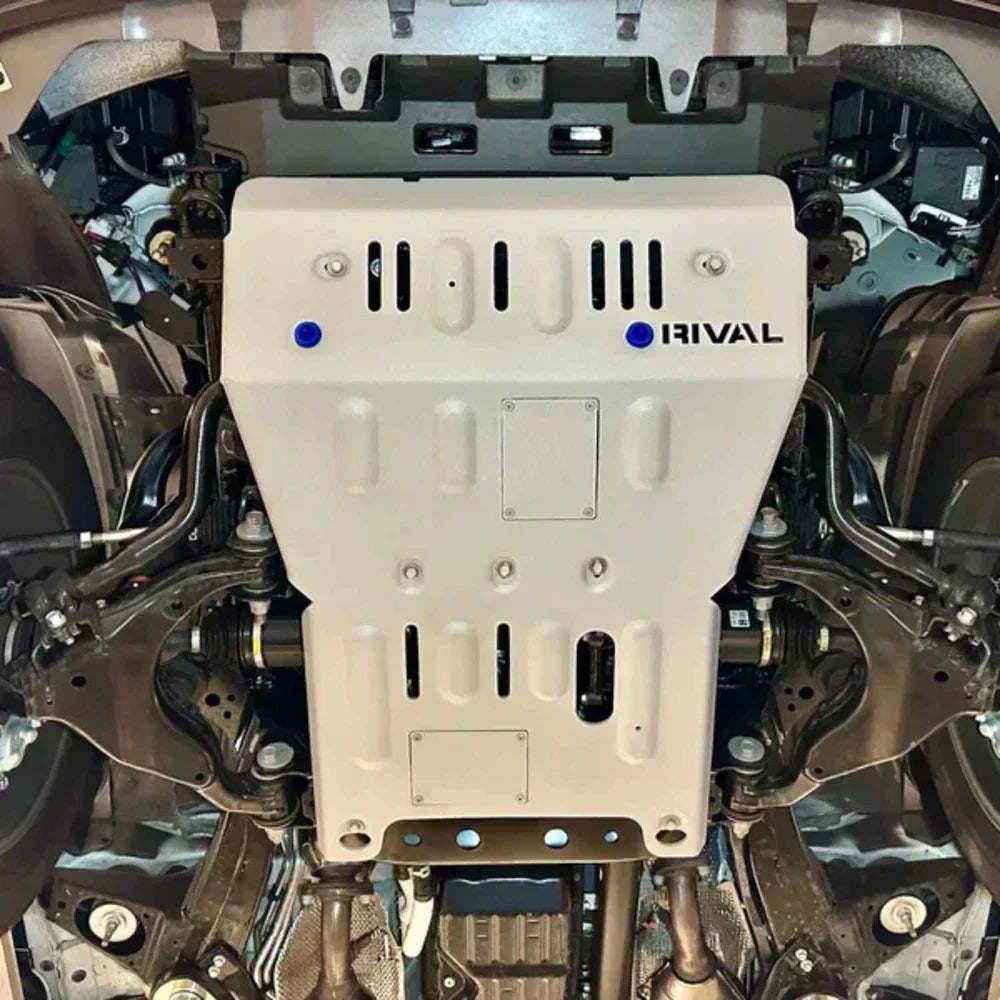
This is a real skid plate — RIVAL Aluminum Engine Skid Plate for Toyota Tacoma. Notice the thickness, mounting flanges, and oil drain access cut-out.
Not sure what's under your truck right now? Crawl under and look. You might be surprised.
It's also worth knowing the difference between a skid plate and a splash shield. They look similar but serve completely different purposes. 👉 Read our full breakdown: Skid Plate vs. Splash Shield
🛡️What Do Skid Plates Protect?
Here's what's actually hanging underneath your truck — and why each part matters. This is the stuff that gets hit when you don't have proper undercarriage protection.
Look at those repair costs. A single oil pan hit can run you $500 to $1,500. A cracked transfer case? $1,000 to $3,500. That doesn't even count the tow truck, the rental car, or the days without your truck.
Would you spend $200–$400 today to avoid a $2,000 repair later? Most people say yes — once they actually see the numbers side by side.
🔨Types of Skid Plates: Materials Compared
Not all skid plates are made the same. The material you choose affects protection, weight, cost, and how long it lasts. Here are your three options — click each tab to explore.
⚙️ Steel Skid Plates
Steel is the tank of skid plate materials. A 3/16" or 1/4" steel plate can take a direct hit from a boulder and keep on going. It bends before it breaks — which is actually a good thing. You can hammer a bent steel plate back into shape. You can't un-crack a broken one.
The downside is weight. A full set of steel skid plates adds 80–150 lbs to your truck. That affects fuel economy, suspension wear, and how your truck handles. It also costs more to lift a heavy truck if that's in your plans.
Best for: Serious rock crawling, hard trail use, dedicated off-road rigs where maximum protection beats everything else.
✅ Pros
Maximum impact resistance
Bends rather than cracks
Lower upfront cost than aluminum
Can be repaired (hammered back)
❌ Cons
Heavy — 2x the weight of aluminum
Rusts if coating chips
Affects fuel economy
Harder on suspension over time
💡 Pro Tip: If you go steel, look for powder-coated options. The coating protects against rust. Touch up any chips quickly — exposed steel corrodes fast, especially if you drive on salted roads.
Aluminum is the sweet spot for most drivers. It's 40–50% lighter than steel, doesn't rust, and still gives solid protection on moderate trails. Brands like RIVAL 4x4 and Cali Raised LED have built their reputation on quality aluminum systems.
The trade-off: aluminum can crack under extreme impacts where steel would just bend. If you're regularly running hard rock lines with large, sharp boulders, steel wins. But for overlanding, forest roads, and trail riding? Aluminum is excellent.
Best for: Overlanding, moderate off-road, daily drivers on rough roads, trucks used in wet or salty climates.
✅ Pros
40–50% lighter than steel
Naturally rust/corrosion resistant
Great for mixed-use vehicles
Wide aftermarket availability
❌ Cons
Can crack under extreme impacts
More expensive than steel
Softer — gouges more easily
Less ideal for aggressive rock crawling
RIVAL Aluminum Engine Skid Plate installed on a 2024 Toyota Tacoma (4th Gen). Clean fitment, minimal ground clearance loss.
💡 Pro Tip: Look for 6061-T6 aircraft-grade aluminum — it's significantly stronger than cheaper alloys. Thickness matters too: 4mm–6mm aluminum gives you real protection. Anything thinner is closer to a splash shield than a skid plate.
UHMW stands for Ultra-High Molecular Weight polyethylene — a type of very tough plastic. It's the lightest option available. It slides over rocks incredibly smoothly (better than metal in some situations). And it never rusts or corrodes.
But here's the honest truth: UHMW won't stop a sharp, direct rock impact the way steel or aluminum will. It's great for sliding over terrain and protecting against scrapes and trail debris. It's not the right call if you're regularly taking hard hits.
Best for: Light off-road, gravel roads, sandy terrain, electric vehicles where weight savings matter, side-by-sides and UTVs.
✅ Pros
Lightest option — minimal weight penalty
Slides over rocks better than metal
Completely corrosion-proof
Good noise/vibration dampening
❌ Cons
Won't take sharp, direct hits well
Can crack or deform under hard impact
Often the most expensive per piece
Not ideal for serious off-roading
💡 Pro Tip: If you go UHMW, look for at least 1/2" thickness (0.5"). Thinner pieces peel back at the edges where they're not bolted down. Thicker UHMW holds its shape much better over time.
You don't have to buy everything at once. Most brands sell individual skid plates for each component — engine, transmission, transfer case, fuel tank, and differentials. You can protect one area at a time and build up as your budget allows.
A full belly skid plate system links all individual plates together into one solid, seamless unit. It's stronger (no gaps for rocks to slip through), looks cleaner, and saves time during installation. The downside is the higher upfront cost — a full system from a quality brand like Cali Raised LED or RIVAL can run $600–$1,500+.
So if budget is a concern, where do you start? Here's the priority order — based on which components are most exposed and most expensive to repair:
1
⛽ Fuel Tank Skid PlateHangs dangerously low on most trucks. A puncture is a fire hazard and instant $800–$1,500 repair.
2
🛢️ Engine / Oil Pan Skid PlateMost exposed part up front. One direct hit = possible engine seizure. High-frequency impact zone.
3
⚙️ Transmission Skid PlateOften overlooked but very expensive to repair. Install this before the front skid — it shares mounting bolts.
4
🔄 Transfer Case Skid PlateThe 4WD brain. Crack this and you're not going anywhere. High priority for 4WD vehicles on trails.
5
🔧 Differential Skid PlatesFront and rear diffs. Add when budget allows, especially if you're running aggressive off-road lines.
RIVAL Transmission + Transfer Case combo — two plates that link together for seamless mid-belly coverage.
⚠️ Installation Order Matters! Always install your transmission skid plate before your front/engine skid plate. Some engine skid bolts overlap with transmission plate mounting points. If you do it in the wrong order, you'll have to remove everything and start over.
🏷️OEM vs. Aftermarket Skid Plates
Should you trust the skid plates that came with your truck? It depends on the truck — and what you do with it.
OEM (factory) skid plates are built to factory spec. Some are legitimately good — like the Toyota Trailhunter plates, which are thick, hardened steel and offer real protection. Many others are thin aluminum or even plastic, designed more to check a box on the spec sheet than to actually protect your truck.
Aftermarket skid plates are almost always made from thicker material, offer better undercarriage coverage, and often include smart features like oil change access doors — so you can drain your oil without removing the entire plate. If you've ever removed your front skid plate every 5,000 miles for an oil change, you know why that matters.
💡 Quick Test: Look at your factory skid plate. Can you see the drain plug through it? If not, you're removing the whole plate every oil change. Aftermarket plates with access doors solve this instantly — and they protect better too.
For popular trucks and SUVs, aftermarket options from brands like RCI Off Road, RIVAL 4x4, and Cali Raised LED offer noticeably better protection than OEM for a reasonable price. For vehicle-specific recommendations, check out these guides:
1 of 4 — How often do you drive off-road or on rough terrain? 🗺️
2 of 4 — What kind of terrain do you typically encounter? 🏔️
3 of 4 — How harsh are your winters or road conditions? 🌨️
4 of 4 — How would a surprise $1,500+ repair bill feel? 💸
💰How Much Do Skid Plates Cost?
Here's a straightforward breakdown so you can budget before you buy:
What You're Buying
Estimated Cost
Single engine/oil pan skid plate (steel)
$150–$300
Single engine/oil pan skid plate (aluminum)
$300–$500
Fuel tank skid plate
$150–$350
Transmission skid plate
$150–$300
Transfer case skid plate
$150–$300
Full belly skid plate system (aluminum)
$600–$1,200
Full belly skid plate system (steel)
$800–$1,500+
Professional installation
$100–$300
Still wondering if it's worth the investment? Look at it this way:
🛡️ Cost of Protection
Engine skid plate: $150–$500
Fuel tank skid: $150–$350
Full system: $600–$1,500
Installation (DIY): $0
Peace of mind: Priceless
💸 Cost of NOT Having One
Oil pan repair: $500–$1,500
Fuel tank replacement: $800–$1,500
Transfer case rebuild: $1,000–$3,500
Tow truck: $150–$500+
Rental car + lost time: $$$
Fuel Tank Skid Plate — Priority #1 for good reason.Cali Raised LED Fuel Tank Skid Plate — solid build quality at a competitive price.
One oil pan hit can cost more than a complete skid plate system. The math isn't complicated — protection is almost always cheaper than repair.
🔧Skid Plate Installation Basics
Good news: most quality aftermarket skid plates are bolt-on installations. No cutting, no welding, no professional fabrication needed. If you can safely lift your truck and use a torque wrench, you can likely do this yourself.
Here's how a typical install goes:
Lift your truck — Use a floor jack and jack stands. Never work under a vehicle supported only by a floor jack.
Locate mounting points — Most plates bolt to existing frame holes. No modifications needed on popular trucks.
Install in the right order — Transmission first, then front/engine skid plate. This is critical (see the callout above).
Torque to spec — Follow the manufacturer's torque specs. Over-tightening cracks mounting points. Under-tightening means rattles and loose plates.
Check after your first trail run — Vibration from off-road use can loosen bolts. Re-check everything after the first time out.
✅ DIY or Professional? A single plate takes about 30–60 minutes if you're comfortable under a lifted truck. A full system might take 2–4 hours. If you're not comfortable with torque specs and working underneath vehicles, pay a shop $100–$300. It's worth it to get it right.
Very slightly. Most quality skid plates mount flush with the bottom of your frame and reduce ground clearance by less than 1 inch. Low-profile designs minimize this even further. In practice, the protection they provide far outweighs the tiny clearance reduction.
It depends on the truck and what "off-roading" means to you. Some factory plates (like Toyota Trailhunter) are genuinely solid. Most others are thin aluminum or even plastic — fine for light use and road debris, but not built for rocks. If you're hitting real trails, aftermarket plates made from 4mm+ aluminum or 3/16" steel are a significant upgrade.
Neither is objectively better — it depends on your use case. Steel wins on maximum impact protection and can be repaired if bent. Aluminum wins on weight savings, rust resistance, and long-term corrosion performance. For most overlanders and trail riders, aluminum is the better all-around choice. For dedicated rock crawlers, steel is the safe pick.
Not always — but more often than people assume. If you drive on rough roads, live somewhere with harsh winters and road salt, or frequently encounter potholes and construction debris, a basic engine skid plate is very cheap insurance. It also protects your catalytic converter, which is a common theft target. If you're on smooth urban roads only, you can probably skip it.
A splash shield (or splash guard) is a plastic panel designed to keep water, mud, and road debris away from engine components. A skid plate is a heavy-duty metal or composite shield designed to take direct physical impacts. They may look similar from the outside but serve completely different purposes. Many trucks have splash shields from the factory that are often mistaken for real protection. Read our full comparison here →
A quality aluminum or steel skid plate can last the entire lifetime of your truck with basic maintenance. Steel plates need periodic inspection for rust — touch up any chips or scratches in the coating quickly. Aluminum plates are lower maintenance but should still be checked for cracks after hard impacts. Re-torque mounting bolts after the first few trail runs and periodically after hard use.
A properly installed skid plate should be nearly silent on the road. Rattles usually mean loose bolts — check torque specs and re-tighten. Composite/UHMW plates can actually reduce road noise compared to bare metal. If you hear scraping on the road (not on trails), your plate may be mounted too low or the vehicle may have suspension sag worth checking.
Aftermarket skid plates are most widely available for popular off-road platforms: Toyota Tacoma, 4Runner, Tundra, Jeep Wrangler and Gladiator, Ford Bronco and Maverick, Ram 1500 TRX, and Chevy/GMC trucks. For less common vehicles, options are more limited but some brands offer universal fit plates that can be trimmed and adapted. Custom fabrication is also an option for unique builds.
🏁 Ready to Protect Your Rig? Here's What to Do Next
You now know everything you need to make a smart decision about skid plates. Here's your quick action list:
🔍 Look under your truck first — check what protection you already have (real steel/aluminum, or just plastic trim?)
⛽ Start with your fuel tank and oil pan — these are the highest-risk, most-impactful first purchases
🪶 Choose aluminum for overlanding, steel for rock crawling — match material to your actual use
🏷️ Check if your OEM plates have oil access doors — if not, aftermarket is worth it for convenience alone
🔧 Install transmission skid first — then front/engine skid. Never the other way around
🔩 Re-check all bolts after your first trail run — vibration loosens hardware
📚 Read the vehicle-specific guide for your truck — Tacoma, 4Runner, Maverick, and more above
Fit and finish first class. I made an error on my initial order, reached out to customer service and they had everything squared away with just a couple of emails. Great communication on shipping and shipping progress. Would definitely use these folks again.
We are very happy the rack fits the painted roof of our ‘25 Bronco Heritage. Leitner right now might be the only company that makes a rack that fits the painted roof. Typical great Leitner attention to detail